
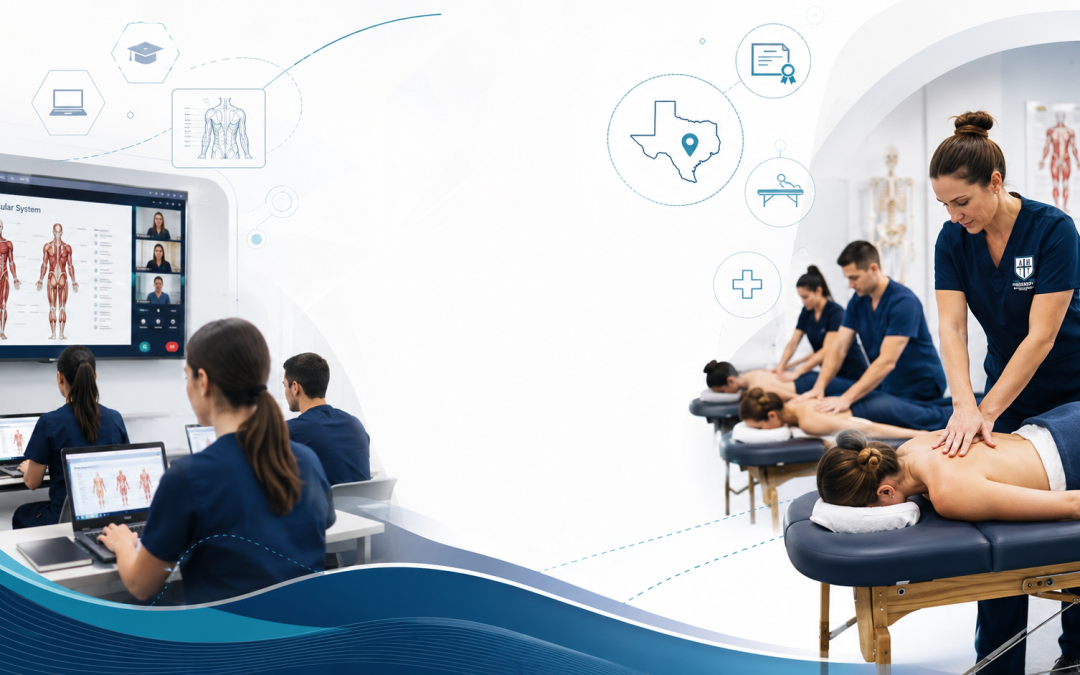
You want to become a licensed massage therapist, but you also have a job, kids, or a schedule that doesn’t leave room for a full-time, on-campus program five days a week. So you start searching for a hybrid option, and now you’re staring at terms like clock hours, TDLR approval, and MBLEx, trying to figure out which programs are legitimate and which ones will leave you stuck at the finish line.
That confusion is normal. Massage therapy is a licensed healthcare profession in Texas, which means the massage therapy school you choose determines whether your hours even count toward your license. Here’s what a compliant hybrid program actually looks like, what to watch for, and how to know if a school is genuinely preparing you to practice, or just collecting tuition.
Hybrid Massage Therapy Training OverviewA hybrid massage therapy program in Texas combines online learning with mandatory in-person training while meeting all state licensing requirements. Students must complete 500 approved hours, pass the MBLEx and Texas Jurisprudence Exam, and apply through TDLR for licensure. Choosing a compliant, TDLR-approved school with qualified instructors, structured clinical internships, and strong exam preparation ensures your training counts toward licensing and prepares you for a successful, long-term career in massage therapy. |
What Makes a Program “Hybrid” in the First Place
A hybrid massage therapy school splits your training between online coursework and in-person, hands-on instruction. In Texas, becoming a licensed massage therapist (LMT) requires completing 500 state-approved training hours, passing the Massage and Bodywork Licensing Examination (MBLEx), passing the Texas Jurisprudence Exam, and applying through the Texas Department of Licensing and Regulation (TDLR).
Hybrid delivery doesn’t reduce any of that. It’s the same 500 hours, the same exams, the same license, just delivered in a format that fits around a job or family responsibilities instead of requiring you to be on campus full-time. The tradeoff is that not every program labeled “hybrid” is actually compliant, which is exactly why understanding the structure matters before you enroll.
Thinking about starting your massage therapy career? Talk to an admissions advisor at the Academy for Massage Therapy Training. We’ll walk you through our TDLR-approved hybrid program, class schedules, and exactly what your path to licensure looks like- no pressure, just clear answers. |
Why You Can’t Do This Entirely Online
Texas caps online instruction at 250 of the 500 required hours; no more than half your training can happen on a screen. Those online hours cover the science and business side of the profession: anatomy, physiology, kinesiology, pathology, and the laws and ethics that govern your license. The other 250 hours must happen in person, on campus, under a licensed instructor, and that time is split between roughly 200 hours of hands-on technique labs, Swedish massage foundations, hydrotherapy, and body mechanics, plus a 50-hour supervised clinical internship working with real clients toward the end of the program.
That split exists for a practical reason, not a bureaucratic one: you cannot learn to feel the difference between a tight muscle and a normal one, or judge how much pressure a client’s body can safely take, by watching a video. Locating a hypertonic muscle, adjusting your body mechanics so you don’t injure your own back over a 20-year career, and reading a client’s nonverbal cues in the room are physical skills. They only develop through repetition, correction, and feedback from someone standing next to you, which is exactly what the in-person hours are built for. You also can’t start that internship until you’ve completed at least 250 hours of foundational coursework, including 100 hours of technique and theory, so you’re not practicing on real people before you have the knowledge to recognize when something is unsafe to treat.
One Thing We Tell Every Prospective Student
A lot of people assume that if a program says “hybrid,” more online hours automatically means more flexibility, so they look for the massage therapy schools in San Antonio with the lightest on-campus schedule. That’s usually the wrong thing to optimize for. A program advertising more than 250 online hours isn’t more convenient; it’s non-compliant, and hours earned that way won’t count toward your license. The real question isn’t how little time you’ll spend on campus; it’s whether the school’s schedule is honest about the in-person commitment upfront, so you can actually plan your life around it.
What to Actually Look for in a Program
Choosing a massage therapy school is a licensing decision as much as an educational one. A handful of things separate a program that sets you up to pass the MBLEx and start working from one that leaves you scrambling after graduation.
- TDLR approval, verified directly through TDLR’s database, not assumed from website or brochure of massage schools in San Antonio
- Instructors who are licensed and actively practicing, with a low enough student-to-instructor ratio that you actually get corrected during labs
- Transparency about MBLEx first-attempt pass rates; ask for the numbers directly, not testimonials
- A real clinical internship structure, not just “hour-filling” time in a room with minimal supervision
- Career support after graduation: connections to spas, wellness clinics, and healthcare settings where graduates actually get hired
If you want an extra quality signal, look for COMTA accreditation (Commission on Massage Therapy Accreditation). It’s voluntary, and fewer than 1% of massage schools nationally hold it, so a school that has it has been evaluated well beyond the state minimum. Because your license depends on your hours being verifiable, the programs that clear these checks also tend to use online platforms that track real engagement, not just whether a browser tab was left open, which protects you as much as it protects the school if TDLR ever needs to verify your hours.
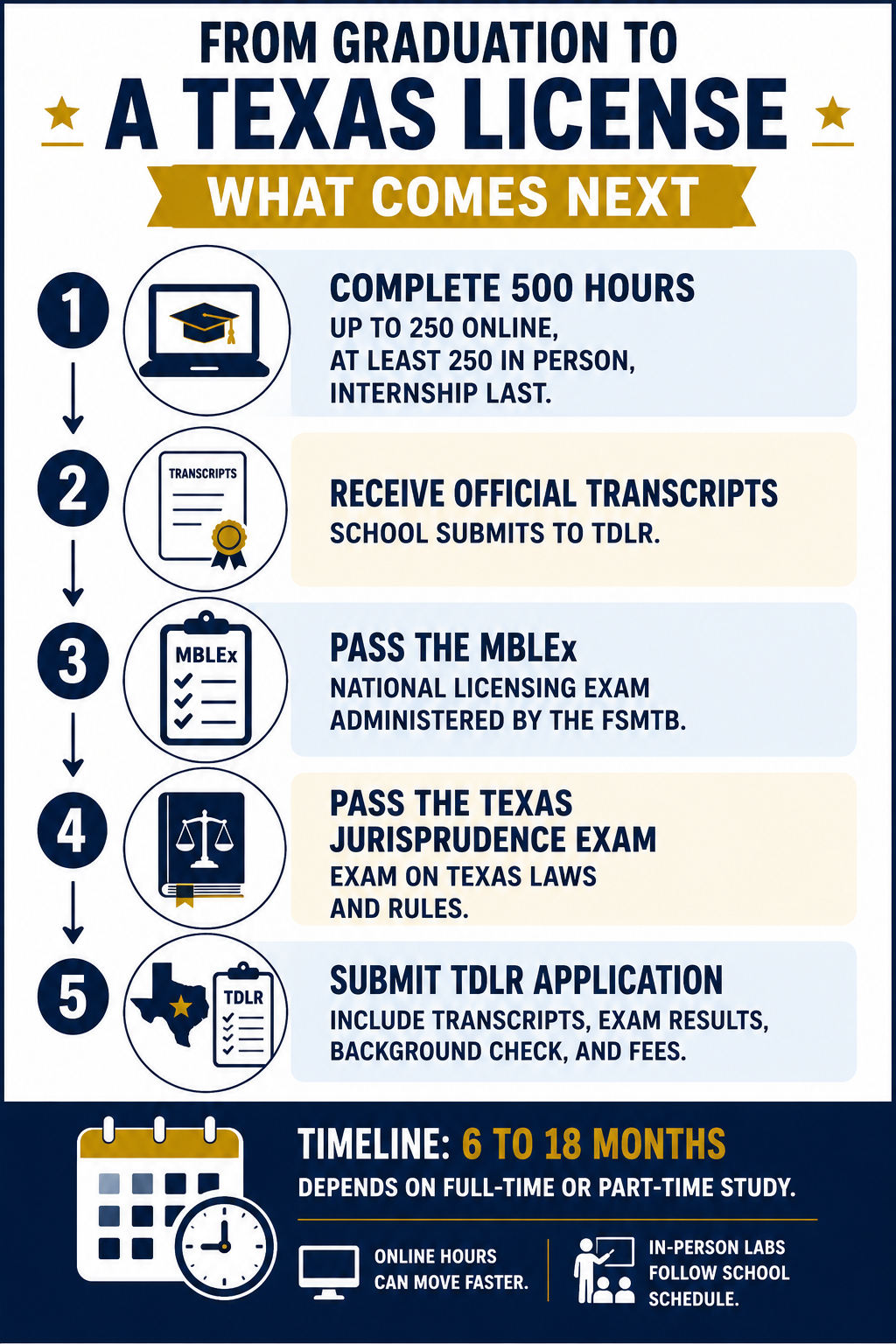
From Graduation to a Texas License: What Comes Next
Before searching for a massage therapy school near me, understanding the licensing process helps you plan your education with confidence and avoid unnecessary delays. This step-by-step roadmap highlights the key milestones from completing your training to earning your Texas massage therapy license.
Most students complete the full 500 hours in 6 to 18 months, depending on whether they’re studying full-time or part-time at Texas massage therapy school. The online portion can move faster if you have the time to dedicate to it, but the in-person labs run on the massage therapy school’s schedule, not yours, so that part of your timeline is fixed.
Is a Hybrid Program the Right Fit for You?
Hybrid training makes sense if you need flexibility for work or family, but still want serious, hands-on preparation for a licensing exam and a real career, not a watered-down version of the training. It’s not a shortcut, and any program marketed as one, with unusually high online hours or a light internship, is a program to walk away from.
Ready to see what your schedule could actually look like? The Academy for Massage Therapy Training offers a TDLR-approved hybrid program right here in San Antonio. Contact our admissions team to review class schedules, ask about our MBLEx pass rates, and get a clear answer on whether our program fits your life. |
Frequently Asked Questions: Hybrid Massage Therapy Programs
1. How long does a hybrid massage therapy program take in Texas?
Most students finish the 500-hour requirement in 6 to 18 months, depending on whether they attend full-time or part-time. Online coursework can move at your pace; in-person labs follow a set schedule.
2. Can I complete a hybrid program almost entirely online?
No. Texas caps online instruction at 250 of the 500 required hours. Any program offering significantly more online hours than that isn’t TDLR-compliant, and those hours won’t count toward your license.
3. Will I be ready to sit for the MBLEx after a hybrid program?
Yes, as long as your program is TDLR-approved and you complete all required hours. Ask any school directly for their MBLEx first-attempt pass rate before enrolling.
4. Does a hybrid program include hands-on training with real clients?
Yes. A required 50-hour supervised clinical internship has you working with real clients under a licensed instructor, after you’ve completed the foundational coursework needed to do so safely.
5. What is COMTA accreditation, and does it matter?
COMTA accreditation is a voluntary quality standard beyond TDLR’s minimum requirements. Fewer than 1% of massage schools nationally hold it, so it’s a meaningful signal of program quality when comparing schools.
6. What should I bring or prepare for in-person training days?
Plan for professional attire, your own linens and a portable table if your program requires practice outside class, and a reliable, distraction-free setup for the online portion, since attendance and engagement both affect your credited hours.