
If you’re already a licensed massage therapist planning a move to Texas, you’ve probably discovered the uncomfortable truth: your license doesn’t just transfer. Texas evaluates every out-of-state applicant individually, and if the state you trained in required fewer hours than Texas does, you could be facing a licensing gap you didn’t know existed until you’re already mid-move.
That’s the part most guides skip. They’ll walk you through TDLR’s paperwork like you’re supposed to figure out your own educational shortfall and fix it solo. You don’t have to. Academy for Massage Therapy Training helps relocating therapists identify exactly where their transcript falls short of Texas requirements and closes that gap fast, so here’s what you’re actually dealing with and how we help.
Licensing Transfer Process OverviewTexas evaluates out-of-state massage licenses individually, requiring substantially equivalent education, examinations, documentation, and background checks. Applicants must meet the 500-hour training standard, complete the Texas Jurisprudence Examination, submit transcripts and license verifications, and undergo fingerprinting. Therapists with educational gaps may complete targeted bridge coursework instead of restarting training. Professional transcript evaluation can prevent delays, while maintaining an approved license requires renewal every two years and 12 continuing education hours. |
Why Your License Doesn’t Just Transfer
Texas doesn’t recognize licenses from other states automatically, no matter how long you’ve been practicing or how clean your record is. The Texas Department of Licensing and Regulation (TDLR) reviews your training, your exam history, and your standing in every state where you’ve held a license, and decides whether it’s “substantially equivalent” to what Texas requires.
Here’s the part that catches people off guard: Texas requires 500 hours of massage therapy education, but plenty of states license therapists with 300 to 450 hours. If that’s your situation, TDLR won’t just ask you to make up the difference on your own time; they’ll require documented coursework from an approved school before your license moves forward. This is exactly the kind of gap that’s easy to miss until it stalls your application.
Relocating to Texas and want a straight answer on what your license transfer will involve?
If You’re Short on Hours, You Don’t Need to Start Over
A lot of relocating therapists assume a shortfall in hours means going back to school from scratch. It doesn’t. If your original program covered fewer hours or skipped topics Texas requires, like specific anatomy, physiology, or state ethics content, targeted bridge coursework at an approved school for massage therapy in Texas can close that gap without repeating training you’ve already completed.
This is where Academy for Massage Therapy Training can help directly: we evaluate your transcript against Texas’s 500-hour standard, tell you exactly what’s missing, and get you into the specific modules you need, not a full program restart.
Think you might be short on hours? Schedule a transcript review with our admissions team before submitting your TDLR application, so you know exactly where you stand.
What TDLR Requires for Your Reciprocity Application
Before submitting anything, gather these pieces so your file doesn’t sit in review waiting on paperwork you could have sent upfront:
- Completed Massage Therapist License Application, filed through TDLR’s online portal, with the non-refundable $100 fee
- Official, certified transcripts showing your total training hours; if your program used different course titles than Texas standards, TDLR may request detailed syllabi to confirm equivalency
- A license verification letter sent directly from every state where you currently hold or previously held a license
- Official Massage and Bodywork Licensing Examination MBLEx score results sent directly from the Federation of State Massage Therapy Boards (FSMTB)
- Proof of passing the Texas Massage Jurisprudence Examination, a state-specific law and ethics test almost every out-of-state applicant has to take
- Clearance from a fingerprint-based criminal background check through TDLR’s approved vendor
Missing or mismatched documents are the single biggest reason these applications sit in limbo, so getting this list right the first time matters more than almost anything else in the process.
Your Path to a Texas License, Step by Step
- Review your hours against Texas’s 500-hour minimum. If you’re short, this is the moment to contact an approved school for massage therapy about bridge coursework, not after TDLR flags it.
- Submit your TDLR application online with your initial documents and the $100 fee.
- Request your official transcripts and license verification letters directly from your former school and state boards.
- Complete the Texas Jurisprudence Exam and schedule your fingerprinting appointment.
- Complete any bridge education TDLR identifies as missing, ideally before this becomes the thing standing between you and your license.
Ready to find out exactly where you stand? Academy for Massage Therapy Training offers transcript evaluations, targeted bridge coursework, and exam prep built specifically for therapists relocating to Texas.
Call (210) 375-2688 or visit academyformassage.com
Why Professional Guidance Makes the Difference in This Process
It’s tempting to treat this as a paperwork exercise you can handle with a checklist and a weekend. In practice, the risk isn’t in any single form; it’s in not knowing what you don’t know until TDLR sends your application back. A missing syllabus, a course title that doesn’t map cleanly to Texas’s curriculum categories, or an hours shortfall discovered three weeks into review can each add a month or more to a timeline that otherwise moves fairly predictably.
This is exactly the kind of process where an admissions team that reviews these applications regularly catches problems before TDLR does, not after. At Academy for Massage Therapy Training, we’ve guided therapists from states with lighter licensing requirements through this exact evaluation, so we know which course categories TDLR scrutinizes most and which documentation gaps cause the most common delays. That means catching a shortfall in week one instead of week six, and walking into TDLR’s review with a file that’s already been checked against the standard they’re applying.
If you’re relocating on a timeline, whether it’s a job start date, a lease, or a family move, that difference isn’t a convenience. It’s the gap between practicing on schedule and sitting on the sidelines for an extra month waiting on a correction you could have caught upfront.
Keeping Your Texas License Active After Approval
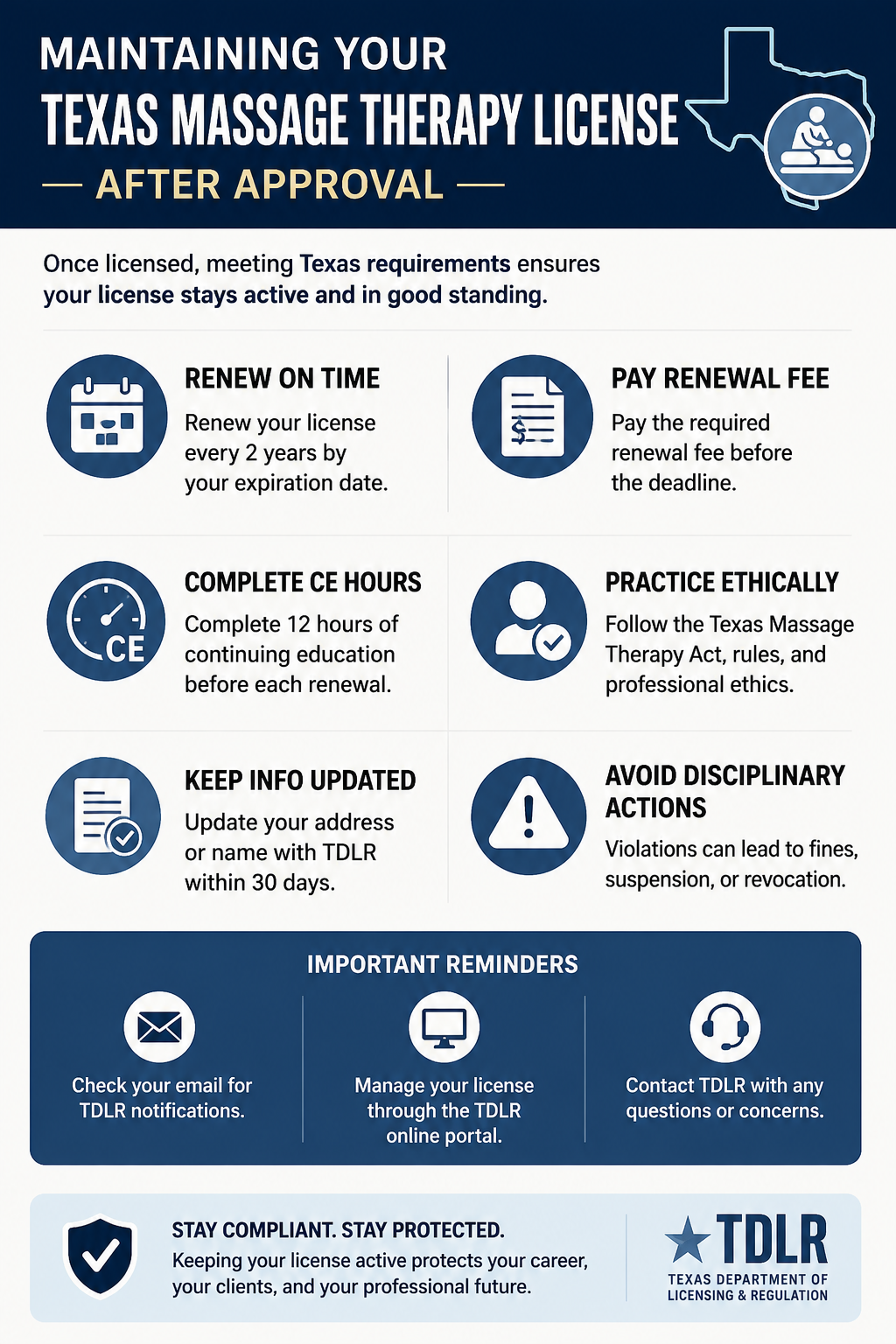
Getting licensed isn’t the finish line. Texas licenses renew every two years, and staying active requires 12 hours of TDLR-approved continuing education per cycle, plus reporting any name or address change to TDLR within 30 days. Therapists who treat renewal as a recurring calendar item, not a last-minute scramble, avoid the gap-and-reinstate headache entirely.
Conclusion
Transferring your massage license to Texas can be easier with the right guidance. Academy for Massage Therapy Training helps out-of-state therapists identify education gaps, complete required bridge coursework, and prepare for Texas licensure requirements. With personalized transcript evaluations and Texas-focused training, the Academy can help you avoid unnecessary delays and take the next step toward practicing massage therapy confidently and legally in Texas.
Ready to build the skills and credentials Texas licensure requires? Academy for Massage Therapy Training offers industry-focused training designed around Texas standards, whether you’re closing a licensing gap or starting fresh.
Frequently Asked Questions: Texas Massage License Reciprocity
Can I practice in Texas while my application is still pending?
No. You need your official Texas Massage Therapist License in hand from TDLR before you can legally provide massage therapy services in the state.
What if my out-of-state massage school has closed?
Contact the department of education or higher education board in the state where you trained to request official transcript records. TDLR may also accept documented work history and license verification in some circumstances.
Does Texas accept licenses from every other state?
No. Every out-of-state applicant is evaluated individually based on whether their education and exam history are substantially equivalent to Texas’s standards; there’s no blanket acceptance list.
How can the Academy for Massage Therapy Training actually help with this process?
We evaluate your transcript against the 500-hour Texas requirement, identify exactly which hours or topics you’re missing, and enroll you in the specific bridge coursework needed to close that gap, plus continuing education once you’re licensed.
Do I need malpractice insurance to practice in Texas?
It’s not required by the state, but many practicing therapists carry it as protection against potential legal claims.
Sources
[1] Texas Department of Licensing and Regulation (TDLR) — Massage Therapy Program Overview
[2] Federation of State Massage Therapy Boards (FSMTB) — MBLEx Examination Requirements