
Maybe you’ve thought a massage sounds nice, but you’re managing arthritis, diabetes, or a condition that makes you nervous about being touched the wrong way. Or maybe it’s a parent or spouse you’re booking for, and you want to know someone will actually pay attention to their needs instead of running a standard routine on them. That hesitation makes complete sense, and it’s exactly why massage therapists in San Antonio don’t treat every client the same way.
A session built for a healthy 30-year-old isn’t the session you’d get, and it shouldn’t be. Here’s what actually changes, why it matters, and what a therapist who knows what they’re doing will ask you before ever placing a hand on you.
San Antonio Massage Therapy Modifications: OverviewMassage therapists in San Antonio tailor sessions for elderly clients and those with chronic conditions like arthritis, diabetes, osteoporosis, neuropathy, or COPD. They assess skin fragility, joint stiffness, medications, and sensation before treatment, then adjust pressure, positioning, and technique accordingly. Sessions prioritize a gentler pace, real-time monitoring, and supportive positioning over standard intensity. Therapists gather health history upfront, ensuring safe, comfortable, individualized care rather than a one-size-fits-all routine. |
Why Your Session Looks Different Than a Standard Massage
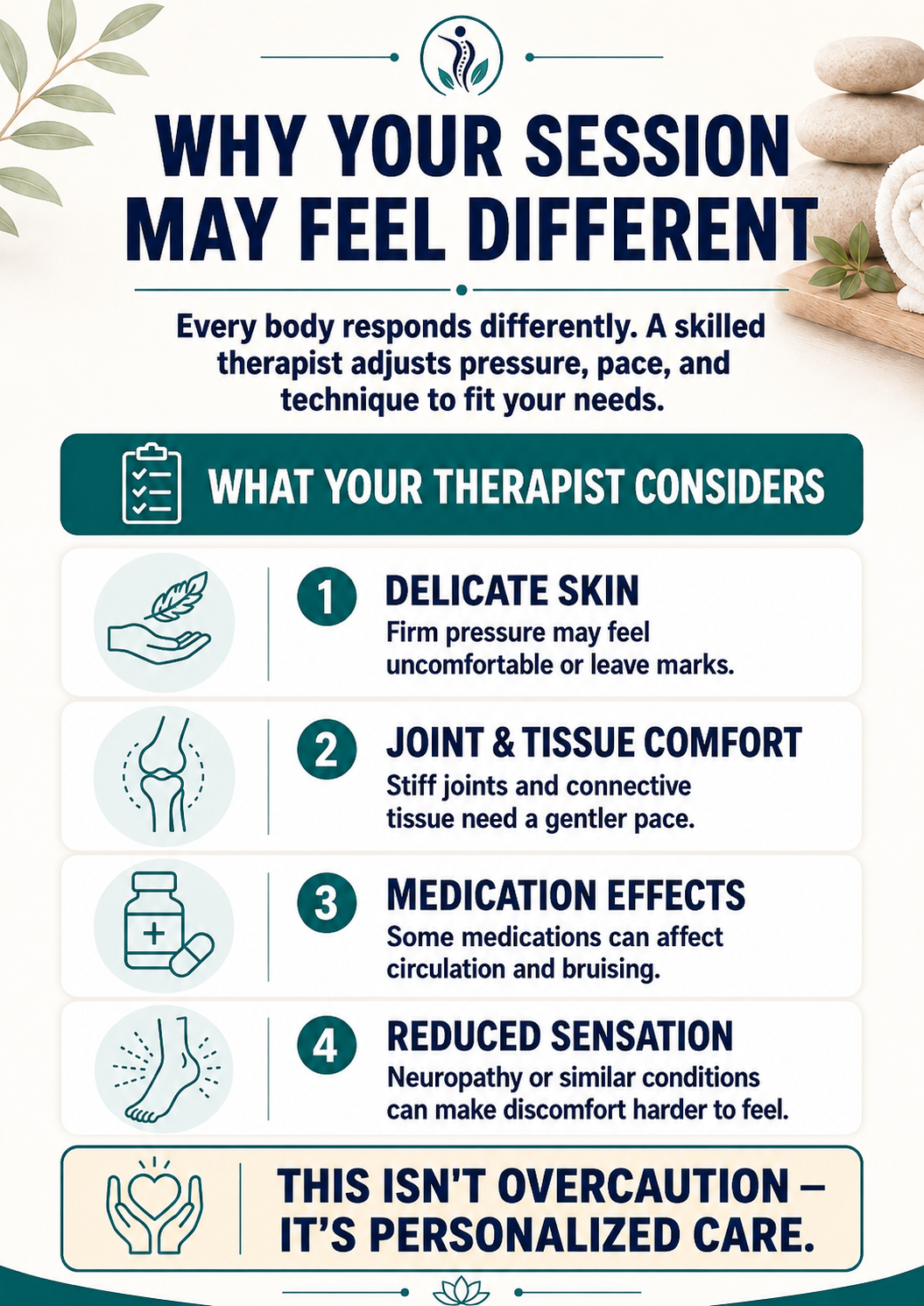
Your body doesn’t respond to touch the same way at every age or under every condition, and a good therapist plans around that instead of hoping for the best.
A few things a trained massage therapist San Antonio clients trust will factor in before your session even begins:
- Skin that’s thinner or more delicate: pressure that feels moderate to a younger client can be uncomfortable or leave marks on more fragile skin, so your therapist checks in before applying anything firm
- Joints and connective tissue that need a gentler pace: stiffer tendons and ligaments recover from pressure more slowly, so techniques favor comfort and gradual progress over intensity
- Medications that can change how your body reacts: some medications affect circulation or bruising, which is exactly why your therapist will ask about what you’re taking
- Reduced sensation in some cases: conditions like diabetic neuropathy can make it harder to feel discomfort accurately, so your therapist watches your body’s response rather than waiting for you to say something
None of this is about being overly cautious for its own sake. It’s about your therapist actually knowing your situation well enough to adjust for it, rather than guessing.
Curious what a session adjusted for your specific health needs would actually involve? Talk to our team before you book; we’ll walk through your history with you first.
How Sessions Are Adjusted for Specific Health Conditions
If you’re managing a specific condition, here’s what a knowledgeable therapist will typically adjust for you, not instead of treating you, but alongside your actual health picture.
Arthritis
Stiff, painful joints don’t need to be avoided entirely; they need a therapist who checks which joints are affected and whether you’re in a flare-up before choosing technique and pressure. Research reviewed by the National Center for Complementary and Integrative Health (NCCIH) suggests massage therapy may help reduce pain and improve certain functional outcomes for people with osteoarthritis and rheumatoid arthritis when the approach fits the person[1].
Diabetes
Since diabetes can affect circulation and reduce sensation, especially in the hands and feet, your therapist will check the skin and surrounding tissue first and steer clear of any areas with wounds or changes that need extra care. A systematic review published in Diabetes Spectrum, “Is Massage Useful in the Management of Diabetes?,” backs this cautious approach, noting the importance of monitoring circulation and bruising risk in clients with diabetes. [2]
Osteoporosis
If your bones need extra consideration, your therapist adjusts pressure specifically around that, not by avoiding treatment altogether, but by choosing techniques that support you without added stress on more vulnerable areas.
Peripheral Neuropathy
When sensation is reduced, your therapist can’t rely only on you saying “that’s too much,” so they watch how your tissue responds throughout the session and adjust in real time. A clinical evidence review, “Manual Massage Therapy for Neuropathic Pain,” published via the National Institutes of Health, supports real-time tissue monitoring as a safe and effective approach for clients with reduced sensation. [3]
Chronic Obstructive Pulmonary Disease (COPD)
Breathing comfortably matters more than anything else here, so positioning is chosen specifically to support easier breathing rather than adding any strain.
Living with one of these conditions and wondering if massage is right for you? We’ll talk it through with you first, no pressure, just an honest conversation about what would actually help.
What Actually Happens Differently During Your Session
- Pressure starts light and builds only as your tissue responds well, never applied at full intensity to fragile skin, inflamed joints, or areas affected by circulation issues
- Positioning may mean side-lying or semi-reclined instead of flat on your back or stomach, with pillows or bolsters supporting your knees, hips, or neck so nothing strains
- Technique is chosen for your comfort level; gentle Swedish massage and slow soft-tissue work are common choices, while more forceful methods are set aside when they wouldn’t serve you
- Movement stays within what’s comfortable for you, slow and controlled rather than pushing toward a range you’re not ready for
- The table itself can be lowered, transfer time can be extended, or chair massage offered if getting onto a traditional table is difficult
- Your therapist checks in throughout, not just at the start and end, asking about comfort, explaining position changes, and watching for anything unexpected
You’re Not Expected to Navigate This Alone
A lot of people put off booking a massage because they assume they’ll have to explain their whole health history and hope the therapist figures out the rest mid-session. That’s not how it should work. A therapist trained to work with older adults and chronic conditions builds that conversation into the start of your appointment, checking your medications, your mobility, and your comfort before treatment begins, not improvising once you’re already on the table.
Ready to experience massage therapy built around your actual needs, not a generic routine? Our team can match you with a therapist experienced in working with older adults and clients managing chronic conditions.
Frequently Asked Questions About Modified Massage Therapy for Seniors and Chronic Illness
What should I bring to my first appointment if I have a chronic health condition?
A list of your current medications and any recent health updates helps your therapist plan your session accurately from the start.
Can sessions be adapted for someone recovering from a recent hospitalization?
Yes. Treatment plans are adjusted to reflect changes in strength, endurance, and overall health following a hospital stay.
Can treatment be modified for clients who use a walker or wheelchair?
Yes. Sessions can be adapted to accommodate mobility aids and individual movement limitations comfortably.
Will my therapist reassess my needs over time?
Yes. Periodic check-ins help ensure your treatment continues to match your needs as they change, rather than staying on autopilot session after session.
Can massage be adjusted for someone who has difficulty staying still?
Yes. Therapists can modify pacing and positioning to accommodate movement-related challenges comfortably.
Sources
[1] National Center for Complementary and Integrative Health (NCCIH) — Complementary Health Approaches for Chronic Pain: What the Science Says
[2] Ezzo, Donner, Nickols, & Cox — “Is Massage Useful in the Management of Diabetes? A Systematic Review” — American Diabetes Association
[3] Guo, Zhong, Chia, Wang, & Xiao (2026) — Manual Massage Therapy for Neuropathic Pain: Clinical Evidence and Mechanistic Insights