
Ask someone outside the massage field what draping means, and most guess it’s about folding a sheet neatly. Ask a licensed therapist in Texas, and you’ll get a very different answer: it’s one of the few skills spelled out word for word in state law, under 16 Texas Administrative Code Section 117.90, and it shapes almost every minute of a session.
That single fact changes how a training program has to teach it. You can’t hand a student a diagram and expect the skill to stick, because draping isn’t really about the sheet; it’s about timing, communication, and staying calm while managing both at once. At AMTT, that’s exactly why an instructor is part of learning this from day one rather than something students pick up through trial and error.
Draping in Massage Therapy: OverviewTexas massage therapy training treats draping as a legal, technical, and communication skill requiring close instructor guidance. State rules require continuous coverage of the genital area, gluteal cleavage, and, unless previously authorized, female breasts. Students learn through supervised practice, real-time correction, client communication, and repeated transitions until draping becomes automatic. Strong programs also prepare students to handle coverage requests calmly, maintain professionalism, and apply standards consistently across every practice setting. |
The Two Rules Everything Else Builds On
Section 117.90 boils down to two non-negotiable coverage requirements, and once you know them, the rest of draping is really just learning how to apply them smoothly in motion. [1]
- The genital area and gluteal cleavage must remain covered at all times, for every client, no exceptions
- As per TDLR, the breasts of female clients must remain covered unless the client has specifically authorized breast work in advance [2]
Every other part of the body can be uncovered, but only while it’s actively being worked on, and it needs to go back under the sheet the moment attention shifts elsewhere. Simple to state, harder to execute for an hour straight without a pause.
Why This Is a Coached Skill, Not a Self-Taught One
Most technical skills in massage therapy can be practiced solo: pressure, pacing, even some sequencing can be rehearsed on a pillow or a willing friend. Draping is different, because getting it wrong doesn’t look wrong to the person doing it. A student can leave a corner loose or forget to re-cover an arm without ever noticing, which is exactly why AMTT keeps an instructor present for this specific part of training far longer than for most other techniques.
An instructor catches what a student can’t see about their own habits: a sheet edge drifting during a stretch, a pause that runs a beat too long before re-draping, a check-in that got skipped because the room felt quiet. None of these show up in a mirror or a textbook, but they show up immediately to someone watching from across the table.
What a Coached Practice Session Actually Looks Like
- A trainer observes a full session on a practice partner, not just isolated drills
- Feedback happens in the moment, right as a habit forms, not days later in a written review
- Students repeat the same transition points until the correction sticks without a reminder
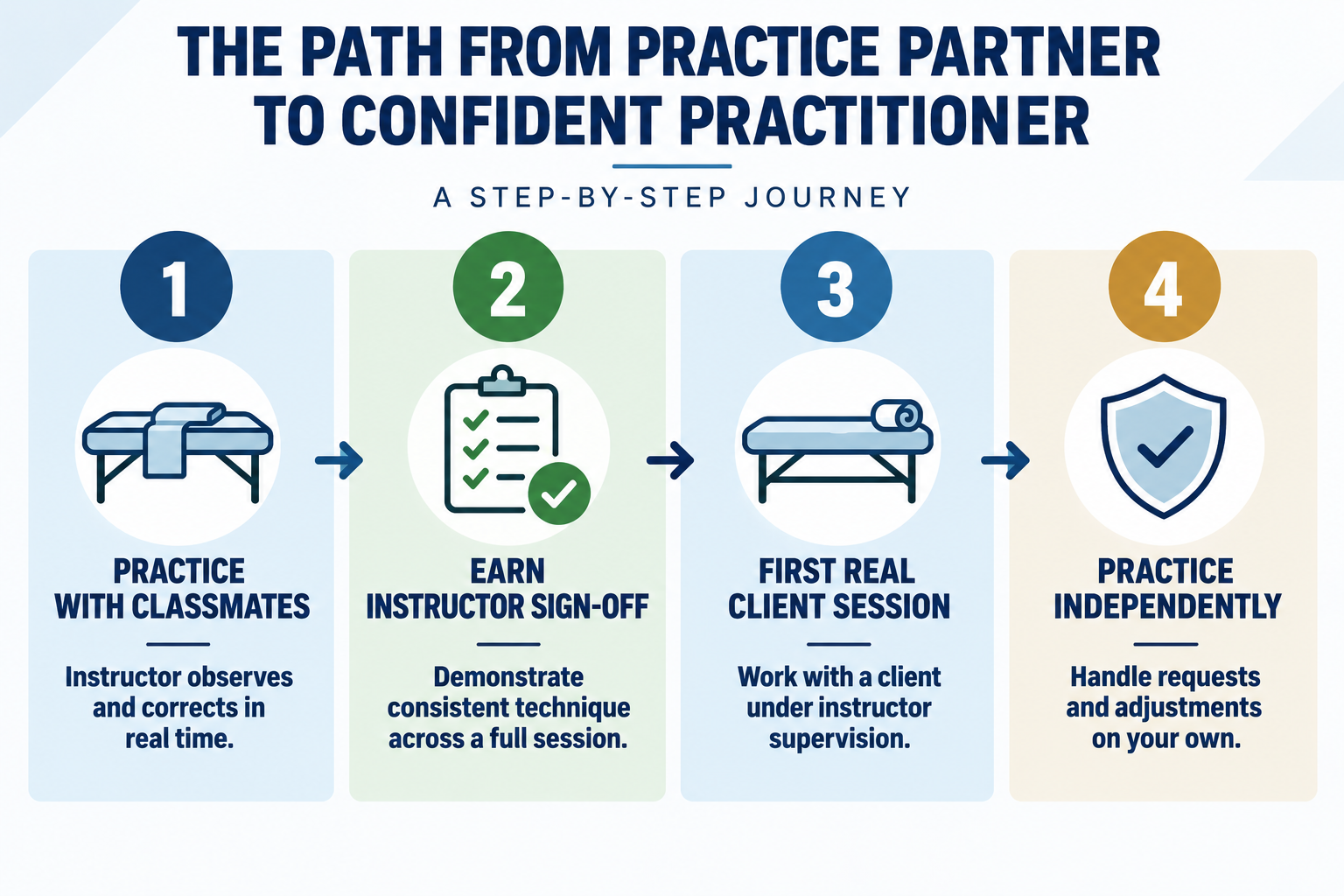
The Path From Practice Partner to Confident Practitioner
This is the stage where draping stops being a rule students recite and starts becoming something their hands do automatically. The MBLEx Candidate Handbook also identifies safe and appropriate draping and communication as part of professional practice, reinforcing why students need to develop these skills through repeated hands-on experience. [3] At AMTT, that progression typically follows a clear sequence.
- Practicing on classmates while an instructor observes and corrects technique in real time
- Getting instructor sign-off once the habit holds steady across a full session
- Running a first supervised session with a real client, instructor still in the room
- Handling requests and adjustments independently, without needing a prompt
Learn professional draping techniques through hands-on training with experienced instructors at AMTT.
When a Client Asks for Something Different Mid-Session
A client requesting extra coverage, or seeming unsure about the process, isn’t something a therapist has to figure out on the fly. It’s a moment every AMTT student rehearses repeatedly before ever facing it with a paying client, which is why it rarely feels like a surprise once someone starts working independently.
A future massage therapist in San Antonio training at AMTT will run through this exact scenario dozens of times in clinic hours, with a trainer nearby coaching the response until it feels natural rather than scripted.
Why the Standard Travels With You, Not the Building
The coverage requirements don’t change based on where a graduate ends up working. Someone offering massage therapy in San Antonio, TX, at a wellness center follows the same rule as someone at a busy massage spa in San Antonio or running an independent practice. What differs is confidence, and that confidence is built long before a diploma, through repetition with someone experienced guiding the process.
What Sets a Well-Trained Therapist Apart
The written exam confirms someone knows the rule. It says nothing about whether they can apply it while also managing pressure, pacing, and a conversation with a real person on the table. That gap only closes with guided repetition, and it’s the clearest sign of how much hands-on coaching a program actually offers.
- Comfort explaining the draping process out loud before a session starts
- Clean, unnoticeable re-draping between different areas of the body
- A calm, practiced response when a client asks for something unexpected
Questions to Ask About Trainer Involvement
Every program in Texas has to teach the same legal standard, but how closely instructors work with students while they practice it varies quite a bit.
- How much one-on-one coaching happens during clinic hours, versus lecture-only instruction
- Whether corrections happen in real time or only during scheduled evaluations
- How experienced the trainers are at walking students through client discomfort or unusual requests
Anyone hoping to eventually offer the best massage in San Antonio should ask about this specifically, since trainer involvement tends to be the real difference between graduates who feel ready and those who don’t.
Ready to learn this skill with an instructor beside you, not just a manual in front of you? AMTT builds coached practice into every stage of clinic training.
Draping Questions, Answered
Why can’t students just learn draping from a handout?
Because the mistakes it involves are hard to notice in yourself, a trainer watching in real time catches slips a student wouldn’t see on their own, which is why AMTT keeps instructors closely involved through this part of training.
Does the draping standard change depending on where someone practices massage in San Antonio?
No. Whether it’s a wellness center, spa, or private studio, 16 Texas Administrative Code Section 117.90 applies exactly the same way everywhere in the state.
What if a client requests less coverage than the rule requires?
The covered areas defined by law- genitals, gluteal cleavage, and female breasts without prior authorization don’t flex based on a client’s request. A trainer helps students practice explaining this clearly and calmly.
How long does it take before draping feels automatic?
It varies by student, but most reach that point after several coached practice sessions, once an instructor has walked them through the same transitions enough times that they stop needing a reminder.
Is draping tested on the state licensing exam?
Yes, but only the rule itself, not the execution. Applying it smoothly with a real person on the table is a separate skill, built entirely through supervised, coached practice.
Sources
[1] Texas Department of Licensing and Regulation (TDLR) — Massage Therapy Laws and Rules
[2] Texas Department of Licensing and Regulation (TDLR) — Massage Therapy Consultation Document
[3] Federation of State Massage Therapy Boards (FSMTB) — MBLEx Candidate Handbook