

If you are considering deep tissue massage, you may wonder whether the session should feel intense, relaxing, or somewhere in between. The honest answer is that effective pressure is personal. It should feel purposeful enough to address the areas you want worked on, but it should never require you to hold your breath, brace your body, or stay silent through sharp pain.
During a Deep Tissue Massage in San Antonio, pressure may range from moderate to firm and can change from one area to another. A thoughtful therapist begins gradually, listens to your goals, pays attention to how your body responds, and adjusts throughout the session. At AMTT, we want you to understand what those adjustments mean so you can participate confidently in your massage rather than guessing what you are supposed to tolerate.
Key TakeawayDeep tissue massage should not be a test of how much pain you can endure. Expect slow, focused work that may create strong pressure, tenderness, or a productive ache in tight areas. You should still be able to breathe normally and relax around the technique. Sharp, burning, electrical, numbing, or escalating pain is a reason to speak up immediately. Clear feedback helps the therapist choose a depth that supports your goals while respecting your comfort and health history. |
Deep Pressure Is a Technique, Not a Pain Goal
The name can make it sound as if the therapist must press as hard as possible. In practice, “deep” describes the intention to work with deeper layers of muscle and connective tissue. Reaching those layers often depends on slow pacing, sustained contact, positioning, and tissue response as much as force.
To better understand how these techniques target muscle tension, explore what deep tissue massage does for muscles and when it may be helpful.
A therapist may begin with lighter strokes to assess and warm an area, then increase depth gradually. Broad pressure from a forearm may feel firm but comfortable, while focused work with a thumb or elbow can feel more intense even with less overall force. The sensation may also change as the therapist moves from a large muscle group to a smaller or more sensitive area.
Cleveland Clinic notes that therapeutic massages may feel deeper and more tender than a relaxation session, but clients should tell the therapist when pressure feels too deep or uncomfortable.[1] That feedback does not interrupt the work. It gives the therapist information needed to make the session more appropriate for you.
What Healthy, Productive Pressure Can Feel Like
There is no universal number on a pressure scale that fits every person. Still, a few body cues can help you decide whether the depth feels useful.
- A broad, steady compression that feels intense but manageable
- A dull or localized ache in a tight area that eases as the technique continues
- A stretching or lengthening sensation that does not feel sharp
- The ability to take a full breath and keep the surrounding muscles relaxed
- A sense that the therapist is working on the intended area rather than pressing indiscriminately
You might describe this as “strong but workable.” The important point is not whether a sensation fits someone else’s idea of deep pressure. It is whether your body can receive the technique without guarding. If your shoulders lift, your jaw clenches, or you pull away, the pressure may be too much at that moment.
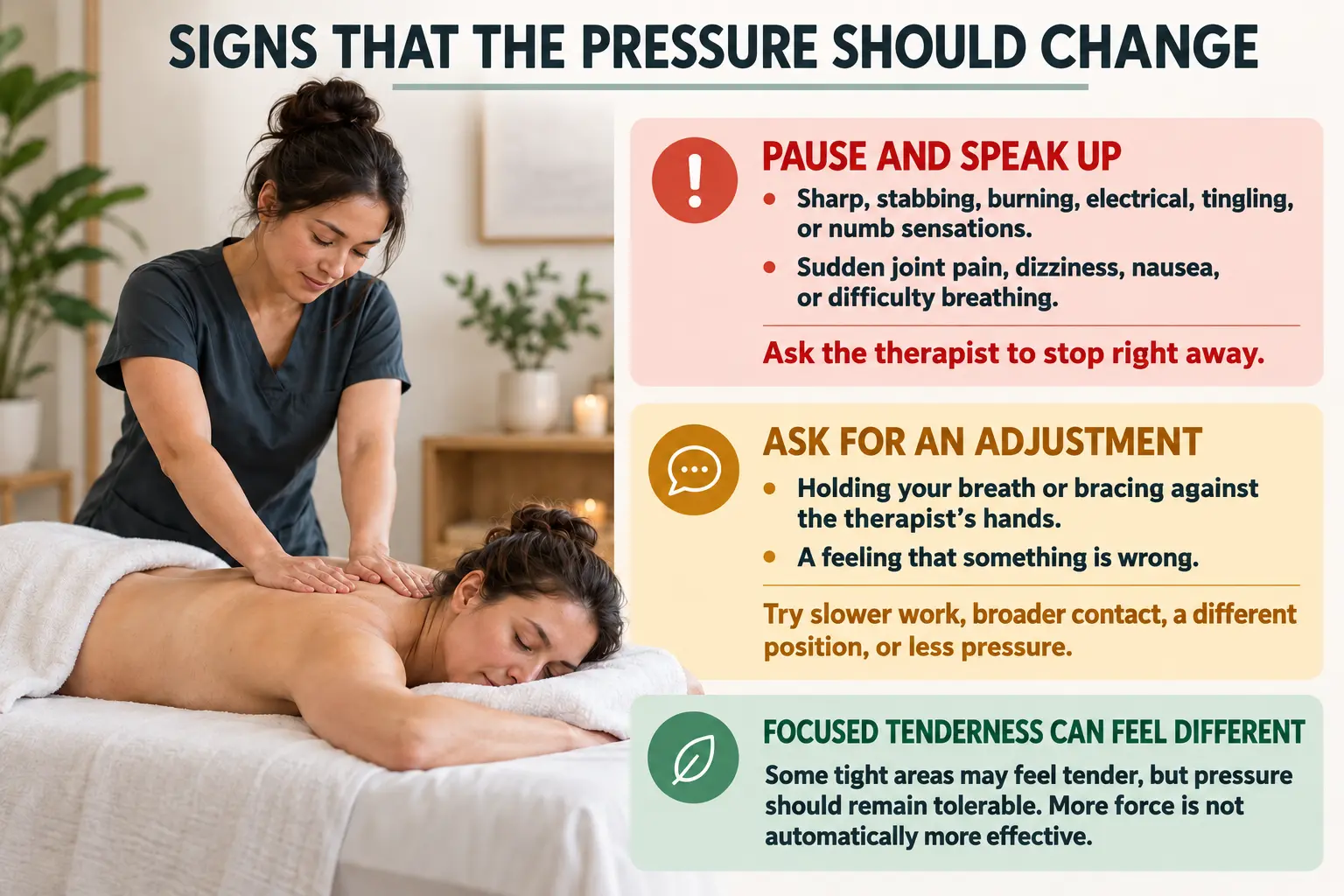
Signs That the Pressure Should Change
Speak up right away if you notice sharp, stabbing, burning, electrical, tingling, or numbing sensations. Sudden joint pain, dizziness, nausea, difficulty breathing, or a feeling that something is simply wrong also deserves an immediate pause. These sensations are different from the concentrated tenderness some people notice when tight tissue is addressed. Communication is central to professional massage care. The American Massage Therapy Association recommends discussing expected pressure during intake and continuing to check comfort during the session, particularly when a client has special health considerations.[2]
Pressure May Vary Across the Same Session
Your back, calves, neck, gluteal muscles, and feet may not tolerate the same amount of pressure. An area with recent irritation may require a gentler approach than a region with long-standing tension. The therapist may also use different techniques to support the same goal, so the session does not need to feel uniformly intense from beginning to end.
Experience can differ from one appointment to the next as well. Sleep, stress, recent activity, hydration, injury status, medication changes, and overall sensitivity can affect how touch feels. Tell your therapist what is different that day instead of assuming the pressure used last time must be repeated.
For a first Deep Tissue Massage in San Antonio, it can help to begin conservatively. Pressure can be increased after you and the therapist learn how your body responds. Starting at maximum intensity leaves less room to make that assessment carefully.
How to Talk About Pressure Clearly
You do not need technical language. Short, specific feedback works well:
- “That feels strong but comfortable.”
- “Please use a little less pressure in that spot.”
- “The pressure is fine, but the angle feels sharp.”
- “Could you stay at this level?”
- “I feel tingling down my arm. Please stop.”
- “My right side is more sensitive today.”
If a therapist asks for a number, think about function rather than proving toughness. A useful intensity lets you stay present, breathe, and communicate. You can also explain whether you prefer broad pressure or focused work and whether a particular area is part of your goal for the session.
Your consent continues throughout the appointment. You may ask for lighter pressure, request that an area be avoided, change position, or end a technique at any time. Cleveland Clinic similarly advises clients to discuss techniques beforehand and communicate during treatment whenever pain causes discomfort.[1]
What Your Therapist Should Ask Before Beginning
A quality intake helps shape pressure safely. Expect questions about your goals, areas of tension, recent injuries, surgeries, medications, health conditions, pregnancy status, and previous response to massage. Share any new diagnosis or change in symptoms even if it seems unrelated to the area being worked on.
Massage is generally low risk when appropriate precautions are used, but vigorous techniques have been associated with rare serious adverse events, particularly in people who may be at greater risk of injury. The National Center for Complementary and Integrative Health advises discussing uncertainty with a healthcare provider and asking about a practitioner’s training and credentials.[3]
Talk with your healthcare provider before booking if you have concerns such as a blood clot, bleeding risk or blood-thinning medication, fragile bones, a recent fracture or surgery, an implanted medical device, a high-risk pregnancy, or another condition that may affect whether massage or firm pressure is appropriate. Massage should not delay medical evaluation for unexplained or worsening pain.[4]
What to Expect at AMTT’s Student Massage Clinic
At AMTT, pre-licensed student therapists provide personalized sessions under the direct supervision of licensed instructors. The session begins with a conversation about your goals and comfort. During the massage, your therapist can adjust the depth, pace, technique, and area of focus based on your feedback.
Understanding the difference between licensed and student massage therapists can also help you know what to expect from a supervised clinic session.
Working with a student therapist does not mean you have to accept a preset routine or pressure level. Learning to listen, check in, and adapt is part of developing professional hands-on judgment. Licensed supervision also provides support when a student needs guidance about technique, client comfort, or whether a concern should be approached differently.
Browse our massage services, compare session options, and find the right fit for your comfort level and goals. Share your preferences at intake, and the clinic will work with them.
Will You Feel Sore Afterward?
Mild tenderness can occur after a session, particularly when you are new to massage or when focused work is performed on tight areas. Cleveland Clinic explains that people respond differently and that deep tissue techniques may cause more soreness than gentler approaches.[5] Any expected tenderness should be manageable and should improve rather than intensify.
Plan a calmer period after the appointment if possible. Gentle movement, normal hydration, and rest may feel supportive. Avoid treating severe pain, extensive bruising, weakness, numbness, or persistent symptoms as a normal sign that the massage “worked.” Contact an appropriate healthcare professional when symptoms are intense, unusual, or do not settle.
Telling your therapist how you felt later is valuable for the next appointment. If you were excessively sore, the next session can use less depth, a shorter period of focused work, or a different technique.
How Much Pressure Is Right for Your Goal?
The right depth depends partly on why you booked the session. Someone seeking general relaxation with one tight shoulder may prefer moderate pressure across most of the body and focused work only where needed. Someone with familiar muscle tension may choose firmer, slower work, provided it remains comfortable and appropriate.
Pressure is only one part of the plan. Session length, pacing, positioning, area selection, and your health history all influence the experience. Research by NCCIH on massage for pain conditions is mixed and often supports only limited or short-term benefits, so deep tissue work should be presented as supportive care rather than a cure or substitute for medical treatment.[6]
A productive Deep Tissue Massage in San Antonio is therefore not defined by the strongest technique available. It is defined by clear goals, informed communication, responsive pressure, and a therapist who treats your feedback as part of the session.
Preparing for Your Appointment
A little preparation makes the pressure conversation easier:
- Identify one to three areas you most want addressed
- Mention current pain, recent injuries, medical conditions, and medication changes
- Describe previous massage experiences, including soreness or bruising
- Explain whether you prefer moderate, firm, or gradually increasing pressure
- Wear or bring information needed to explain a recent diagnosis or provider recommendation
- Plan to give real-time feedback instead of waiting until the session ends
If you’re new to massage, understanding what happens during your first massage therapy appointment in San Antonio can help you feel more prepared.
You do not need to arrive with a perfect description. Your therapist can ask follow-up questions and begin gradually. The goal is a collaborative session in which you remain informed and in control.
Choose Pressure That Helps You Stay Present
Good deep tissue work can feel strong, focused, and specific without becoming an endurance exercise. You should not have to choose between saying nothing and stopping the entire session. Small adjustments in force, pace, position, or technique can make the work both more comfortable and more useful.
At AMTT, we are alongside you in that process. Tell us what you hope to address, what feels sensitive, and how your body responds as the session progresses. A well-communicated Deep Tissue Massage in San Antonio gives the therapist better information and gives you a clearer, more confident experience.
Ready for Focused Bodywork at Your Pace? Choose a session length, then tell the clinic which areas and pressure preferences matter most to you.
Deep Tissue Massage: Frequently Asked Questions
Should deep tissue massage hurt?
It may feel intense or tender in a focused area, but it should not create sharp, burning, electrical, or alarming pain. Ask the therapist to adjust immediately if you tense, hold your breath, or feel unsafe or uncomfortable.
Can I ask for lighter pressure during a deep tissue session?
Yes. Deep tissue describes an approach, not a requirement to use maximum force. You may request lighter pressure, slower pacing, broader contact, a different technique, or that an area be skipped at any time.
Is soreness normal after deep tissue massage?
Mild, short-lived tenderness can occur, especially after focused work or a first session. Severe, worsening, unusual, or persistent symptoms are not something to ignore. Contact a healthcare professional when you are concerned.
What should I tell the therapist before the massage?
Share your goals, sensitive areas, injuries, surgeries, diagnoses, pregnancy status, medications, implanted devices, and previous reactions to massage. This information helps the therapist determine whether techniques or pressure need to be modified.
Is firmer pressure always more effective for muscle knots?
No. Effective work may combine warming, slow pressure, positioning, movement, and focused techniques. Excessive force can make you guard against the work. The best depth is the one your body can receive safely and comfortably.
How long should my first deep tissue session be?
The right length depends on how many areas you want addressed and how you respond to focused work. A shorter appointment can suit one or two priority areas, while a longer session allows a slower pace or broader plan. The clinic can help you choose when booking.
Editorial Sources
[1] Cleveland Clinic, Massage Therapy: https://my.clevelandclinic.org/departments/wellness/integrative/treatments-services/massage-therapy
[2] American Massage Therapy Association, Better Client Communication: https://www.amtamassage.org/publications/massage-therapy-journal/better-client-communication/
[3] National Center for Complementary and Integrative Health, Massage Therapy: What You Need To Know: https://www.nccih.nih.gov/health/massage-therapy-what-you-need-to-know
[4] Cleveland Clinic, Therapeutic Massage: https://health.clevelandclinic.org/therapeutic-massage-can-great-addition-treatment
[5] Cleveland Clinic, How To Relieve Muscle Soreness After a Massage: https://health.clevelandclinic.org/why-does-my-body-feel-worse-after-a-massage
[6] NCCIH, Massage Therapy for Health: What the Science Says: https://www.nccih.nih.gov/health/providers/digest/massage-therapy-for-health-science