

Massage therapy is a solid and secure career within the wellness and healthcare field. In Texas, entering this profession involves completing a state-approved training program, meeting licensing requirements, and building strong hands-on clinical skills. The process is carefully regulated to ensure every practitioner is properly trained through a combination of classroom learning and supervised practice. In this blog, we’ll walk you through each step so you can move forward with clarity and avoid delays on your path to a successful, long-term career.
Key Takeaways
|
What Massage Therapy Is and How It Is Defined Under Texas Law
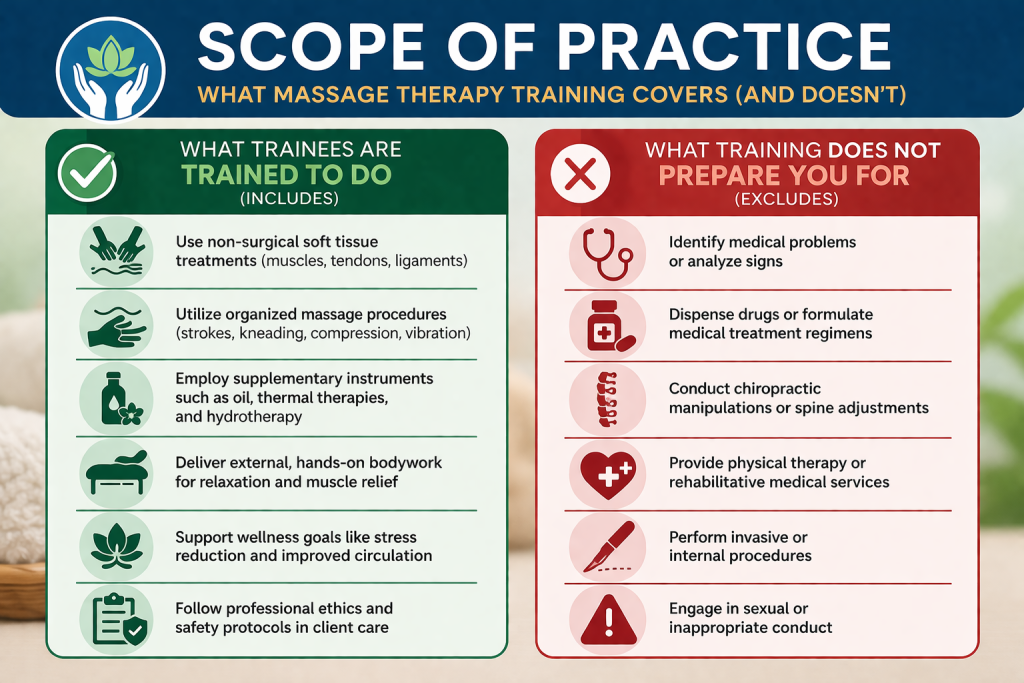
According to Chapter 455 of the Texas Occupations Code, massage therapy refers to the manipulation of soft tissues, including muscle and connective tissues, through hand movements and the use of mechanical and electrical devices. The process involves kneading, stroking, pressing, vibration, and rubbing, with the aim of improving blood circulation and reducing stress levels.
What Activities Require a License Under Texas Law
In Texas, a license is required when an individual:
- Performs massage therapy for compensation
- Uses protected titles such as “massage therapist.”
- Operates or manages a massage establishment
How Massage Therapy Differs From Other Bodywork Modalities
| Aspect | Massage Therapy | Other Bodywork Modalities |
| Legal Status | Regulated profession in many regions | Often unregulated |
| Licensing | License or certification required | Usually not required |
| Training | Formal, standardized training hours | Varies, often informal or flexible |
| Scope of Practice | Clearly defined (soft tissue work, limited therapeutic care) | Broad but limited in legal claims |
| Medical Claims | Allowed within the regulated scope | Generally not allowed |
| Classification | Healthcare / complementary therapy | Wellness / holistic practices |
| Title Protection | “Massage Therapist” is legally protected | Titles like “Bodyworker” are usually not protected |
| Legal Responsibility | Must follow strict laws, ethics, and standards | Fewer legal obligations, but must avoid misleading claims |
What Does the Scope of Licensed Practice Include and Exclude?
How Texas Regulates the Massage Therapy Profession
Scope of TDLR Responsibilities
The regulatory process is entirely managed by the Texas Department of Licensing and Regulation (TDLR) concerning the regulation of the massage therapy profession in Texas.
- Requirements for Licensing and Qualification: The candidates will have to undergo an assessment to evaluate their qualifications and credentials.
- Regulation of the Practice of Massage in Business: Standards are established in business establishments for providing a safe environment and compliance with legal practices.
- Monitoring for Regulatory Compliance: Inspections are done periodically to ensure compliance with sanitation standards and professional conduct.
- Actions Regarding Investigation of Violation Complaints: Should there be any complaints about violations committed, thorough investigations will be conducted on them, and if necessary, disciplinary actions will follow.
- Education Requirements for Licensing Renewal: In order to renew one’s license, some form of educational requirements has to be met.
- Public Safety and Professional Standards: On an even wider scale, there are uniform rules set up in order to ensure professional ethics and public welfare.
How Oversight Transferred From DSHS to TDLR in 2017 and What Changed
The transfer was accomplished in 2017 through legislation that transferred the jurisdiction from the Texas Department of State Health Services to the Texas Department of Licensing and Regulation. The responsibilities, documentation, and licensing process were transferred, enabling the TDLR to take complete charge of the profession of massage therapy.
Texas Administrative Code Chapter 117 Provisions
Chapter 117 of the Texas Administrative Code provides guidelines on operational and regulatory procedures concerning the massage therapy practice in Texas. The code contains rules regarding the application process, licensing fees, examinations, instructor qualification, and school accreditation. In the course of the regulations, the code sets forth training standards, which accredited schools are expected to observe. This includes the curriculum and clinical hours as stipulated in sections 16 Texas Administrative Code §117.59 and 16 Texas Administrative Code §117.50. Furthermore, the code sets forth the guidelines on advertisement practices, record-keeping, intake procedures, and license posting at facilities.
How the Massage Therapy Advisory Board Functions Under TAC §117.10–117.14
Under the provisions provided in Chapter 117 of the Texas Administrative Code, the Massage Therapy Advisory Board shall operate on an advisory basis in relation to the Texas Department of Licensing and Regulation. The advisory board consists of appointees, definitions, and an officer in charge, conducting meetings regarding different aspects of the profession.
What the 500-Hour Coursework Requires According to the Texas Administrative Code
Coursework has been developed to provide knowledge as well as practical skills. The main coursework normally includes:
- Anatomy & Physiology involves learning about the human body and how it functions
- Pathology provides information on common diseases that may require modification of the massage treatment
- Kinesiology explains body movement and the role muscles play during exercise
In addition to this basic scientific education, the course also incorporates professional training and techniques. This guarantees that students are ready to work in practical conditions.
Training in the following areas is an important component of the course. They provide knowledge on how to act professionally and safely. These are:
- Business operations: Client relations, time management, record keeping, and practice management
- Professional ethics that belong to this group include the scope of practice, client confidentiality, professional conduct, and law
- Health and Hygiene Requirements: Sanitation; infection control; personal hygiene; and safety at work
Additionally, much attention is paid to teaching the technique of Swedish massage because this method is mandatory and provides students with basic knowledge and skills necessary for practice. Among these techniques are:
- Basic techniques such as effleurage, petrissage, friction, tapotement, and vibration
- Proper body mechanics to ensure therapist safety and prevent strain
- Client positioning and draping techniques to maintain comfort and professionalism
- Application of full-body relaxation massage routines as part of supervised practice
How Distance Learning Is Permitted in Texas Massage Education
Distance learning in Texas massage education became formally allowed after the passage of Senate Bill 1130 (2021) and the rulemaking that followed in December 2021.
Before 2021:
- Massage education had to be fully in-person.
After 2021 changes:
- Schools are now allowed to deliver part of the 500-hour curriculum online.
- Distance learning is not limited to live classes; it can include:
- Recorded lectures
- Self-paced modules
- Interactive online activities
Which Parts of the Curriculum Can Be Delivered Remotely Under TAC §117.59
Under 16 TAC §117.59, distance learning is allowed—but with strict conditions on what type of content can be taught online.
Allowed Through Distance Learning
These are primarily theoretical and academic subjects, such as:
- Anatomy & physiology
- Kinesiology
- Pathology
- Ethics and laws
- Business practices
- Theory-based massage concepts
These fall under the instructional hours that do not require physical manipulation skills.
Additionally, the rules require that online learning must include:
- Student identity verification
- Tracking of hours completed
- Active participation (academic engagement)
- Instructor, student interaction (live or delayed)
Why the Internship Portion Cannot Be Completed Through Distance Learning
This is one of the most important regulatory restrictions.
Under §117.59(e):
- The internship must include hands-on massage practice
- It must be completed:
- At a licensed massage school
- With an instructor physically present and available
- It cannot be offered through distance learning
Reason Behind This Rule
The internship is designed to ensure:
- Real client interaction
- Development of tactile skills
- Immediate instructor correction and supervision
- Safe and professional practice standards
What TDLR Approval Is Required Before a School Offers Online Instruction
A school cannot independently decide to start online education; it must obtain approval from TDLR.
Required Approval Steps
- The school must submit a distance education request to TDLR
- The request must demonstrate compliance with:
- Curriculum standards (500-hour structure)
- Distance learning rules under §117.59
- TDLR reviews and approves the entire program structure, not just individual courses
What TDLR Evaluates
Before approval, the school must prove it can:
- Track and document student participation
- Ensure academic engagement
- Maintain instructor interaction
- Supply needed study materials
TDLR issues a certificate of curriculum approval only after approval, which enables the institution to function legally.
Clinical Practice and Internship Standards
How the Internship Component of Massage School Is Structured in Texas
Here are the most important required points:
1. Entry Requirement
- Students must complete at least 250 hours of training before starting an internship
- Must include core massage techniques and theory
2. Required Hands-On Practice
- Includes 40–50 hours of real client massage sessions
- Part of the total 500-hour curriculum
3. Location Restriction
Internship must be completed only at a licensed massage school. Off-site or external internships are not allowed because they will ensure:
- direct, on-site instructor supervision at all times
- Maintains consistent training standards and regulatory compliance
- Protects client safety and controlled learning conditions
4. Supervision Requirement
- A licensed instructor must be present and available at all times
- Students work in a controlled student clinic setting
5. Real Client Experience
- Students perform massages on actual clients (public)
- Includes intake, session, and basic client interaction
6. No Payment Rule
- Students cannot be paid during the internship
- It is strictly educational, not employment
7. Program Integration
- An internship is a required part of course completion
- Must be finished to become eligible for licensure
What a Student Permit Is and How It Governs Student Practice
A student permit is a legal authorization issued by the Texas Department of Licensing and Regulation that allows massage therapy students to practice on the public during training before becoming licensed.
Who Is Required To Hold A Student Permit (TAC §117.25)
- All students enrolled in a licensed massage school must hold a valid student permit
- Required before performing any massage services on the public
What A Student Permit Allows And Does Not Allow
Do’s:
✔ Allows practice only within the school’s training program
✔ Requires on-site practice at the licensed school
✔ Requires continuous supervision by a licensed instructor
Do Nots
✘ Does not allow independent or unsupervised practice
✘ Does not allow students to present themselves as licensed therapists
Student Compensation Rules And Their Purpose
- Students cannot receive payment for massage services
- This rule:
- Protects clients from paying for unlicensed services
- Prevents student exploitation in commercial settings
Transition From Student Permit To Licensure
- The student permit is valid only during training
- After completing the program:
- The permit no longer applies
- Students must obtain a massage therapist license to practice legally
Ethics, Law, and Professional Conduct
What Texas Law Requires Regarding Professional Ethics for Massage Therapists
In Texas, professional ethics for massage therapists are defined by law, not left to interpretation. Under TAC Chapter 117, Subchapter H (§117.90–§117.93), therapists must meet specific, enforceable standards related to conduct, documentation, client protection, and public representation.
General Ethical Obligations (TAC §117.90)
Texas law requires therapists to:
- Avoid fraud, misrepresentation, or deceptive practices
- Practice with competence and without negligence
- Maintain professional boundaries, with zero tolerance for sexual misconduct
- Refrain from practicing under the influence of drugs or alcohol
- Comply with all state licensing and operational laws
Client Recordkeeping Requirements
- Maintain accurate and legible records of services, dates, and billing
- Keep records for a minimum of 2 years
- Ensure records are confidential and securely stored
- Provide records if required by regulatory authorities
Client Protection And Consent (TAC §117.91)
- Obtain informed consent before treatment
- Secure parent/guardian consent for minors
- Clearly communicate services and charges when requested
Advertising And Representation (TAC §117.93)
- All advertising must be truthful and not misleading
- Must accurately reflect license status and qualifications
- Prohibited from making false or unverifiable claims
Sanitation And Safety Standards (TAC §117.92)
- Maintain clean, sanitary facilities, equipment, and linens
- Follow proper hygiene and draping practices
- Ensure a safe environment for every client
What Constitutes A Violation
Texas law treats the following as ethical violations:
- Sexual misconduct or boundary violations
- Fraudulent billing or charging for unperformed services
- Practicing in unsafe or unsanitary conditions
- Allowing unlicensed individuals to perform massage
- Any conduct that endangers clients or violates state law
How Client Consent, Draping, and Session Protocols Are Governed in Texas
Client Intake And Written Consent
Before starting any session, you are expected to:
- Conduct a client intake process, including relevant health history and session goals
- Obtain informed consent based on that intake
- Ensure consent is clearly established and documented where applicable, especially for first-time or specific treatments
This step ensures that treatment decisions are informed, appropriate, and legally supported.
Draping Standards And Enforcement (TAC §117.92)
Texas rules require strict draping practices during every session:
- Only the area being treated may be exposed
- Genitals and sensitive areas must remain fully covered at all times
- Draping must be maintained in a way that prevents accidental or inappropriate exposure
Failure to follow proper draping is treated as a serious regulatory violation.
Special Consent Requirements For Minors
When working with minors:
- You must obtain prior consent from a parent or legal guardian
- Consent should be documented before the session begins
- Extra care must be taken to ensure clear boundaries and appropriate session conduct
Session Documentation And Billing Obligations
For every session, you are required to:
- Maintain accurate documentation of services provided
- Record dates, treatment details, and session outcomes where relevant
- Ensure billing reflects only the services actually performed
These requirements help prevent disputes, ensure transparency, and protect both the therapist and the client.
Licensing Exams and the Application Process
What Examinations Are Required to Become a Licensed Massage Therapist in Texas
To obtain a massage therapy license in Texas, you must pass two required exams and meet the application standards defined under TAC §117.22 (exam requirements) and §117.20 (application process). These exams ensure you understand both practical competencies and Texas-specific laws.
1. The MBLEx (Primary Licensing Exam)
The Massage & Bodywork Licensing Examination (MBLEx) is the main competency exam accepted by Texas.
- Administered by the Federation of State Massage Therapy Boards
- It is delivered as a computer-based test through Pearson VUE testing centers
- You are required to demonstrate entry-level professional competency
What The MBLEx Covers
The exam tests your knowledge in the subjects that we have discussed earlier.
- Anatomy, physiology, and kinesiology
- Pathology and contraindications
- Massage techniques and application
- Client assessment and treatment planning
- Professional ethics and guidelines
2. The Texas Jurisprudence Exam (State Law Requirement)
In addition to the MBLEx, Texas requires a Jurisprudence exam administered by the Texas Department of Licensing and Regulation.
- Focuses on Texas laws and rules governing massage therapy
- Covers:
- TAC Chapter 117
- Scope of practice
- Ethical and legal responsibilities
- Typically completed online as part of the licensing process
3. Score And Timing Requirements (TAC §117.22)
- You must achieve a minimum passing score of 630 on the MBLEx, as set by the Federation of State Massage Therapy Boards
- The MBLEx is typically completed after your training (or near completion) and before applying for licensure
- Exam results must be valid and submitted at the time you apply to the Texas Department of Licensing and Regulation
- Both the MBLEx and the Texas Jurisprudence exam must be completed before your license is issued.
4. Application Eligibility (TAC §117.20)
Before or alongside exams, you must:
- Complete a 500-hour approved massage therapy program
- Submit an application to the Texas Department of Licensing and Regulation
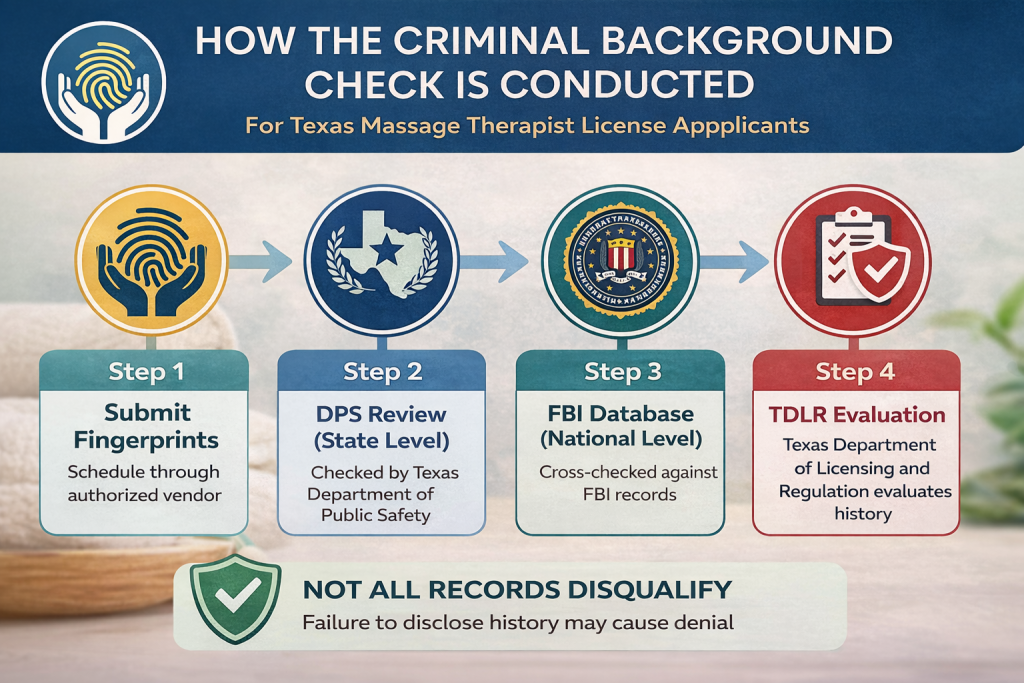
- Meet any additional requirements, such as background checks if applicable
How to Apply for a Texas Massage Therapist License Through TDLR
When you apply for a license, Texas law (under TAC §117.20 and the Texas Occupations Code) requires specific documents, verification steps, and review procedures. Let’s check below what you need for applying:
What Documents And Credentials Are Required
When applying through the Texas Department of Licensing and Regulation, you must provide:
- Proof of completing a 500-hour approved massage therapy program
- MBLEx exam results (sent from the Federation of State Massage Therapy Boards)
- Completion of the Texas Jurisprudence exam
- A completed license application form
- Payment of the required application fee
These documents confirm that you meet education and competency standards.
How The Criminal Background Check Is Conducted
What Happens After You Submit Your Application
Once your application is submitted to the Texas Department of Licensing and Regulation:
- TDLR reviews:
- Education credentials
- Exam results
- Background check status
- If anything is missing, you’ll receive a request for additional information
Processing Time
- Typical approval time is 2 to 4 weeks (can vary based on documentation and background check clearance)
- Once approved:
→ Your license is issued
→ You can legally begin practicing
How Substantial Equivalence Works (Out-Of-State Applicants)
If you are already licensed in another state, Texas may grant licensure through substantial equivalence:
- Your previous license must have requirements equal to or higher than Texas standards
- You must show proof of:
- Education hours
- Passing a recognized exam (like MBLEx or equivalent)
- TDLR evaluates whether your credentials match Texas requirements
If approved:
- You may not need to repeat the full training
- But you may still need to complete the Texas Jurisprudence exam
What Continuing Education Texas Massage Therapists Must Complete for Renewal
In Texas, license renewal is tied to mandatory continuing education (CE) requirements defined under TAC Subchapter D (§117.30–§117.34). These rules define exactly how many hours you need, what counts, and how compliance is verified.
Total CE Hours Required (TAC §117.30)
- You must complete 12 hours of continuing education every renewal cycle (2 years)
- CE must be completed before submitting your renewal application
Mandatory Subject Areas
Texas requires specific topics within those 12 hours:
- At least 1 hour in Human Trafficking Prevention Training (state-mandated)
- At least 1 hour on Texas laws and rules related to massage therapy
The remaining hours can be completed in approved professional subjects.
What Does NOT Count As CE (TAC §117.32)
The following activities are not accepted for CE credit:
- Courses unrelated to massage therapy practice
- Repeating the same course for credit within the same renewal cycle
- General business or marketing courses not tied to clinical practice
- Courses from non-approved providers
Approved CE Providers (TAC §117.32–§117.33)
- CE courses must be taken from approved providers recognized by the Texas Department of Licensing and Regulation
- This may include:
- Licensed massage schools
- Professional organizations
- TDLR-approved CE providers
Recordkeeping And Proof (TAC §117.34)
- You must keep proof of CE completion (certificates, transcripts) for at least 4 years
- The Texas Department of Licensing and Regulation may conduct random audits
- If you fail to provide valid records, you will face penalties, audit findings, or renewal issues
How Texas Massage Therapy Licenses Are Renewed and What Happens If They Lapse
Massage therapy licenses are issued for a fixed 2-year term and must be renewed through the Texas Department of Licensing and Regulation. Renewal is governed by both TAC rules and the Texas Occupations Code, with strict deadlines and penalties for late action.
Two-Year License Term And Renewal Deadlines
- Your license is valid for 2 years and expires on a specific date assigned by TDLR
- The expiration date is fixed (not based on when you renew)
- You must complete renewal on or before this expiration date to remain in active status
What You Must Complete For Renewal
- 12 hours of continuing education (CE) within the renewal cycle
- Submit your renewal application through TDLR
- Pay the required renewal fee
Late Renewal Fees And Penalties (Texas Occupations Code)
If you miss your deadline, Texas applies tiered late renewal fees:
- Up to 90 days after expiration: You can renew by paying 1.5 times the renewal fee
- 91 days to 18 months after expiration: Have to pay 2 times the renewal fee
- 18 months to 3 years after expiration: Renewal may still be allowed with approval and 2 times the renewal fee
- More than 3 years after expiration: You must reapply as a new applicant and meet current licensing requirements
These penalties increase the longer your license remains expired.
What Happens When Your License Expires
- Your license becomes inactive immediately after expiration
- You cannot legally practice massage therapy
- Practicing with an expired license is treated as unlicensed practice under Texas law, which can lead to penalties
Renewal Requirements For Massage Instructors
Massage therapy instructors must also renew every 2 years, but with additional requirements:
- Complete standard CE requirements plus instructor-specific education
- Maintain compliance with teaching and curriculum standards
- Submit renewal through the Texas Department of Licensing and Regulation, like other licensees
Massage Therapy Instructor Qualifications in Texas
What Texas Law Requires to Become a Licensed Massage Therapy Instructor
Under TAC §117.40–§117.41, Texas sets specific, measurable requirements for massage therapy instructors. These focus on verified practice experience, formal instructor training, and clearly defined teaching roles.
Active Practice And Experience Requirements (TAC §117.40)
To qualify as a licensed instructor, you must:
- Hold an active massage therapist license
- Have at least 1 year of licensed massage therapy practice
Document a minimum o
- f 500 hours of hands-on massage therapy experience, excluding internship hours
These are mandatory thresholds; applications without verifiable experience do not qualify.
30-Hour Adult Learning Course Requirement
You must complete a 30-hour course in teaching adult learners from an approved provider. The course must cover:
- Instructional methods for adult education
- Lesson planning and curriculum delivery
- Student evaluation and learning assessment
- Classroom management and instructional communication
This requirement is specifically for teaching competency, not massage technique.
What A Licensed Instructor Must Teach
Under Texas rules, a licensed massage therapy instructor is required to teach:
- Massage therapy techniques and manipulation of soft tissue
- Hands-on practical training and demonstrations
- Supervised student clinic (internship) sessions
Only a licensed instructor can oversee and evaluate practical skill performance.
Qualifications For Non-Technique Instructors (TAC §117.40)
Texas allows subject-matter instructors for non-practical coursework, but with strict limits; they:
- may teach non-technique subjects only, such as:
- Anatomy and physiology
- Kinesiology
- Pathology
- Business or ethics
- must have documented education or credentials in the subject they teach
- are prohibited from teaching massage manipulation or supervising hands-on training unless they meet full instructor licensing requirements
Renewal Requirement (TAC §117.41)
- Instructor licenses are valid for 2 years
- You must maintain an active massage therapist license to renew
- No additional CE hours beyond therapist requirements are specified
What Licensed Instructors Are Responsible for Under Texas Massage School Rules
According to the Texas Administrative Code Chapter 117, licensed teachers are required by law to provide instruction, supervise students, and ensure that all rules and regulations are followed in a massage school. This requirement is necessary for the legality of the operations of the school.
Instructor Presence During In-Person Instruction
- A licensed instructor must be physically present during all in-person training hours
- Instruction cannot be conducted without direct supervision
- The instructor must be immediately available to students at all times
This ensures training is actively supervised.
Oversight During Internship And Student Clinic (TAC §117.59)
- Instructors must be on-site during all student clinic sessions
- Provide direct supervision when students perform massage on the public
- Ensure all services meet legal, safety, and professional standards
Students cannot perform internship work without instructor oversight.
Delivering Curriculum And Evaluating Competency
Licensed instructors must:
- Teach the state-required curriculum under TAC §117.59
- Provide both theoretical instruction and hands-on training
- Evaluate student performance and confirm competency before program completion
Instructor License Renewal And CE Requirements
- Instructors must maintain an active massage therapist license
- Renewal follows the same 2-year cycle as therapists
- Must complete 12 hours of continuing education (CE) for renewal
Without an active license, an instructor cannot legally teach.
Compliance And Recordkeeping Responsibilities
- Ensure all training complies with Texas laws and TDLR rules
- Maintain accurate attendance, progress, and training records
- Records must be available for review by the Texas Department of Licensing and Regulation
What Happens If A School Operates Without A Licensed Instructor
- A massage school cannot legally operate or conduct classes without a licensed instructor
- Violations may result in:
- Administrative penalties or fines
- Suspension or revocation of the school’s license
This is a serious compliance requirement, not a procedural detail.
Texas Regulatory Framework for Massage Schools
How Texas Licenses and Inspects Massage Therapy Schools
Massage schools in Texas are regulated by the Texas Department of Licensing and Regulation under TAC §117.50–§117.55. These rules define exactly how a school gets licensed, inspected, and monitored before and after approval.
What TDLR Requires To Obtain A Massage School License (TAC §117.50)
To receive a license, a school must submit a complete application that includes:
- A state-compliant curriculum meeting required training hours
- Identification of licensed instructors
- A physical facility that meets classroom and practical training standards
- Required application fees and documentation
A school cannot begin instruction or enrol students until TDLR approves the license.
Pre-License Inspection Requirement
Before a license is issued, TDLR conducts a pre-license inspection to verify:
- The facility is fully set up and operational
- Classrooms and clinic areas meet space, equipment, and safety standards
- Required equipment (e.g., massage tables) is available
- The school is ready to deliver the approved curriculum
This inspection is mandatory because a school must demonstrate full compliance before operating, not after.
Approval Of Additional Or Changed Locations (TAC §117.51)
- A massage school must obtain separate approval from TDLR for each location
- Any new location, relocation, or change of address requires:
- A new application or amendment
- Approval before offering instruction at that site
Operating at an unapproved location is a regulatory violation.
Ongoing Inspection Authority (TAC §117.55)
TDLR has the authority to inspect schools at any time, including:
- Unannounced inspections
- Routine compliance checks after licensing
Inspectors may review:
- Facility conditions and sanitation
- Instructor presence and supervision
- Student attendance and training records
- Compliance with curriculum and legal requirements
Schools must cooperate fully and provide access to records and premises.
What Facility, Equipment, and Safety Standards Apply to Texas Massage Schools
Physical Space And Equipment Requirements (TAC §117.53)
A licensed massage school must maintain a permanent, approved facility that:
- Provides adequate classroom space for theoretical instruction
- Includes a designated clinic area for hands-on training
- Has sufficient space to allow safe instruction and supervision
Equipment requirements include:
- Massage tables and training equipment sufficient for enrolled students
- Clean linens, towels, and instructional materials
- Equipment must be functional, maintained, and appropriate for curriculum delivery
Health And Safety Standards (TAC §117.54)
Schools must maintain ongoing compliance with sanitation and safety rules, including:
- Keeping all facilities, equipment, and linens clean and sanitary
- Maintaining a safe environment for students and clients
- Following proper hygiene and waste disposal practices
These are continuous obligations, not just pre-licensing requirements, and are enforced during inspections.
Student Hour Accounting Requirements
Texas requires schools to maintain accurate and verifiable records of student training hours:
- Track actual attendance and hours completed for each student
- Ensure reported hours match the instruction actually delivered
- Maintain records that support eligibility for licensure
Inaccurate or incomplete records can lead to compliance violations.
Enforcement And Penalties For Non-Compliance
If a school violates these standards, the Texas Department of Licensing and Regulation may take action, including:
- Administrative penalties (fines)
- Orders for corrective action
- Suspension or revocation of the school license
Serious or repeated violations can result in loss of authorization to operate.
Conclusion
We hope you are clear with how massage therapy training, licensing, and regulatory compliance work in Texas. If you’re now looking for a reliable place to begin your training, consider Academy for Massage Therapy Training. We offer structured programs designed to meet Texas licensing requirements, helping you move from training to licensure with clarity. So contact us today!
FAQ’s
Q1. What Skills Are Most Important To Succeed As A Massage Therapist?
Key skills include:
- Strong communication and client interaction
- Good physical stamina and body mechanics
- Understanding of anatomy and techniques
- Professional ethics and boundaries
Q2. Where Do Massage Therapists Typically Work In Texas?
Common workplaces include: spas and wellness centers, chiropractic or medical offices, fitness centers, self-employed or private practice settings.
Q3. Can I Start My Own Massage Business After Getting Licensed?
Yes, many therapists choose to become self-employed, but they must also comply with:
- Local business regulations
- Establishment licensing requirements (if applicable)
Q4. Can I Work Part-Time As A Massage Therapist?
Yes, many therapists work part-time or flexible schedules, making it a suitable career for those seeking work-life balance.
Q5. I am an international student. So am I eligible to enroll in Massage Therapy Schools in Texas?
Yes, but you must meet the school admission requirements, visa and eligibility conditions, state training and licensing requirements.