
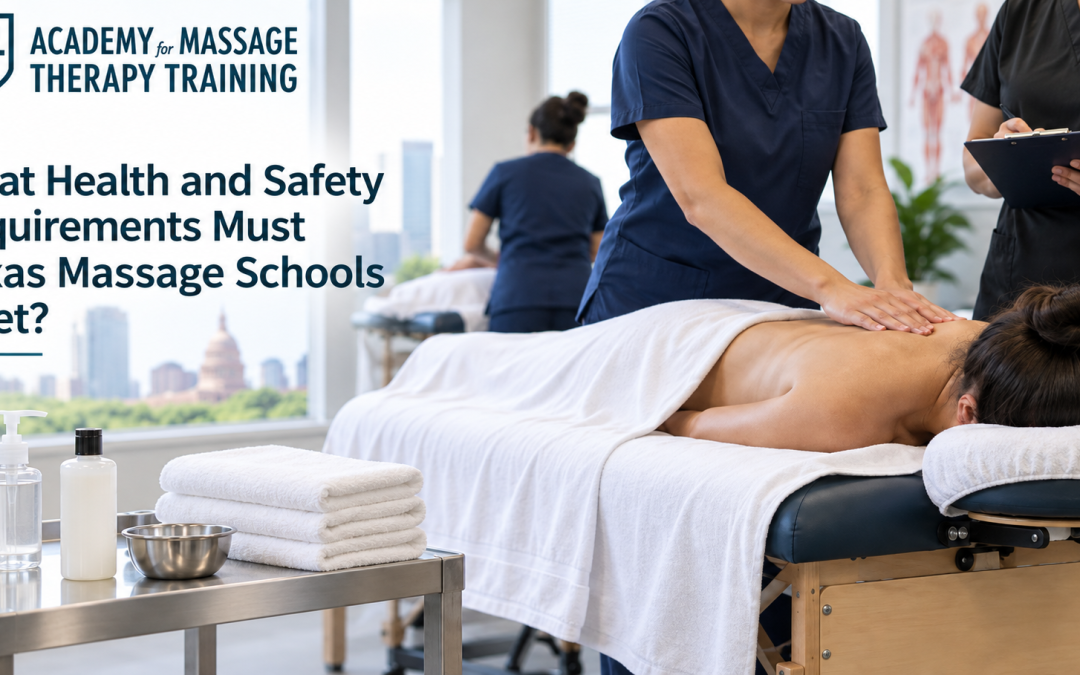
Touring a massage therapy school, you’re probably paying attention to the classroom, the instructors, and maybe the tuition sheet in your hand. What’s easy to miss is the layer underneath all of that: whether the school actually meets Texas’s health and safety standards for hands-on training. Under the Texas Department of Licensing and Regulation (TDLR), every licensed massage therapy school has to follow specific rules covering sanitation, linens, equipment, and instructor supervision, standards set out in 16 Texas Administrative Code Section 117.54.
We’re breaking these down not to overwhelm you with regulations, but so you know exactly what to look for and what to ask when you’re comparing programs.
Texas Massage School Health Safety OverviewTexas massage schools must follow TDLR health and safety rules covering sanitation, clean linens, washable equipment, safe electrical devices, restroom hygiene, lubricant storage, and daily trash removal. Licensed instructors must supervise all in-person training, while internships begin only after 250 coursework hours, including 100 hours of massage theory and techniques. Prospective students should verify TDLR approval, inspection history, sanitation procedures, instructor ratios, and internship supervision before enrolling at any program. |
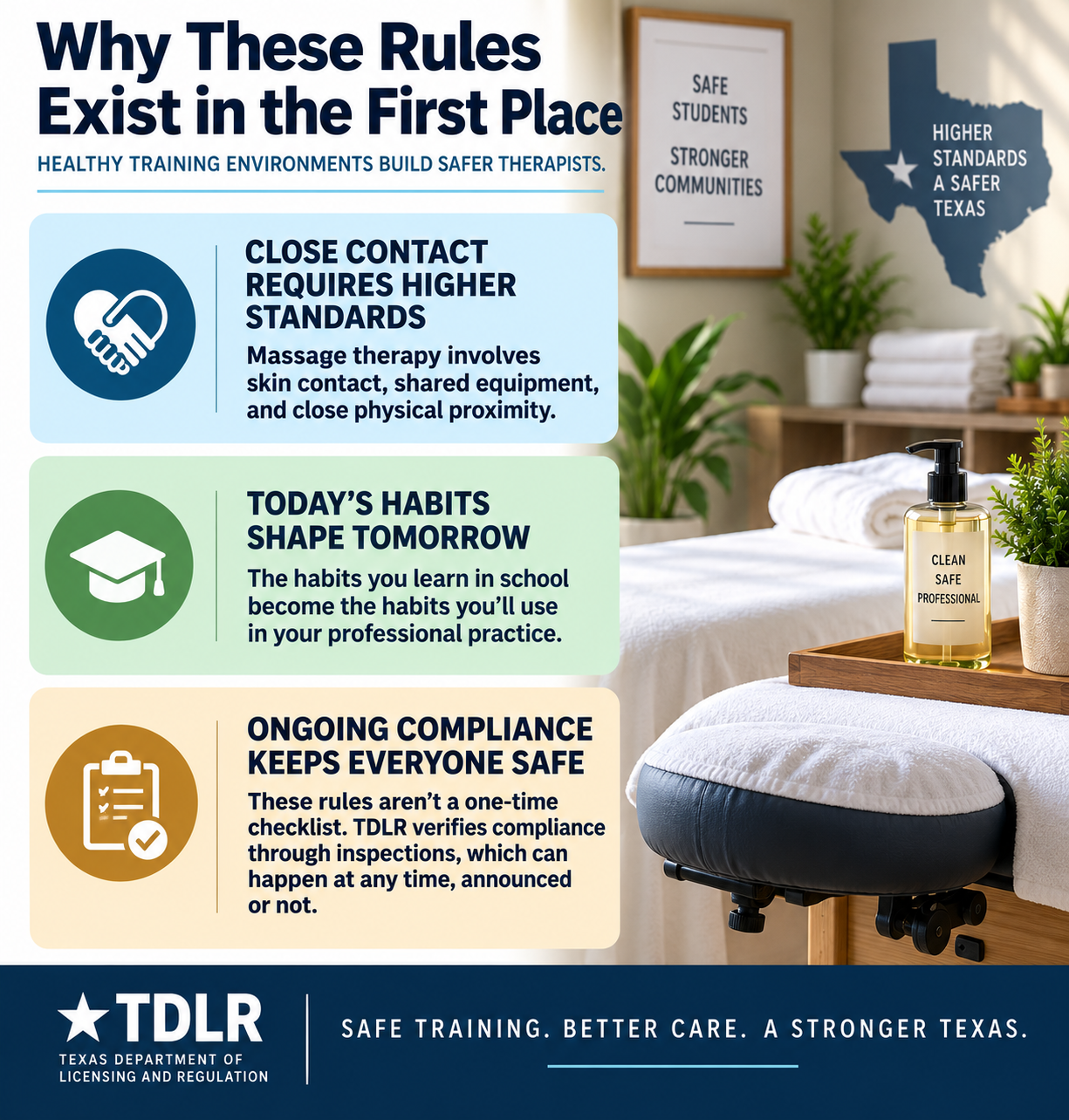
Why These Rules Exist in the First Place
Massage therapy involves sustained skin contact, shared equipment, and close physical proximity between people who’ve often just met, so Texas treats the training environment with the same seriousness it treats a licensed clinic. The idea is straightforward: the habits you build in a classroom clinic are the habits you’ll carry into your own practice, so the standard has to be right from day one.
One thing worth knowing before you tour a campus: these rules aren’t a one-time checklist a school clears before opening its doors. Texas Department of Licensing and Regulation (TDLR) treats them as an ongoing obligation, verified through inspections that can happen at any time, announced or not.
Not sure what questions to ask on a campus tour?
Sanitation Standards Every Massage Therapy School Must Follow
A handful of specific, practical standards apply to every TDLR-approved school for massage therapy, and they cover far more ground than a general sense of cleanliness.
Hand-Washing and Restroom Requirements
Every school must provide hand-washing facilities with both hot and cold running water, positioned near the restroom. Restrooms have to stay sanitary at all times and can’t double as storage space, a rule that sounds minor until you notice how often it gets overlooked at older facilities.
Linen and Lubricant Handling
- Clean linens are required for every client and every student practice session, no exceptions
- Used linens go into a closed or partially closed container until they’re laundered in hot water with chlorinated bleach
- Disposable sheets or protectors that can’t be disinfected are discarded immediately after a single use
- Lubricants, including oils, must stay in closed containers rather than sitting open on a treatment table between sessions
Facility and Equipment Condition
- Massage tables, furniture, and other fixtures must be washable, kept clean, and in good repair
- Electrical equipment has to stay sanitary and in safe working condition
- Trash containers must be emptied daily
None of this is glamorous, but it’s exactly the kind of daily habit that separates a school taking its clinic seriously from one just clearing the bare minimum before an inspection.
Supervision Standards That Protect You During Hands-On Training
Health and safety at a massage therapy school isn’t only about sanitation; it’s also about who’s watching while you practice. A licensed, TDLR-approved instructor has to be physically present during all in-person training hours, and instruction legally cannot happen without that direct supervision.
Why Supervision Timing Matters for Your Internship
The same principle carries into your supervised clinical internship, and the sequencing here is deliberate, not arbitrary.
- Students can’t begin internship hours until they’ve completed at least 250 hours of coursework
- That coursework must include a minimum of 100 hours of massage therapy techniques and theory
- A licensed instructor must be immediately available on-site for the entire internship as stated by TDLR
That structure exists so you’re never practicing on real clients before you’re actually ready, and it’s a standard we hold ourselves to closely at AMTT.
What to Actually Ask When You’re Comparing Schools
If you’re comparing schools for massage therapy near you or weighing options across San Antonio and the wider region, confirming TDLR approval is the first filter. Confirming how seriously a program treats its health and safety obligations is the second, and it’s the one most applicants skip.
- How recently has the school passed a TDLR inspection, and were there any findings?
- What’s the instructor-to-student ratio during hands-on clinic hours?
- How are linens and equipment handled between student practice sessions?
- When exactly does the supervised internship begin, and who’s present during it?
A program that answers these clearly and specifically is telling you something real about how it will train you, and eventually, how you’ll be expected to treat your own clients.
From Classroom Standards to Client Care
The sanitation and supervision habits built during training carry directly into the work of a massage therapist. San Antonio clients trust since the same hygiene and safety practices required in a school clinic are what TDLR expects in a licensed massage establishment. If you want to see what that client-facing side of the profession looks like once you’re licensed, our team at AMTT also works alongside local practices, and you can explore the full range of massage services our graduates go on to provide.
At the Academy for Massage Therapy Training, we walk every applicant through our facility, our sanitation practices, and our clinic supervision structure before they enroll- no pressure, just a clear look at what your training environment will actually be.
Frequently Asked Questions: Health and Safety at Texas Massage Schools
Does every massage therapy school in Texas follow the same health and safety rules?
Yes. Any school licensed by TDLR, regardless of size or location, must meet the same requirements under 16 Texas Administrative Code Section 117.54, covering sanitation, linens, equipment, and facility upkeep.
Can TDLR inspect a massage school without warning?
Yes. TDLR can conduct both routine and unannounced inspections at any time after a school is licensed, reviewing sanitation, instructor supervision, and student records as part of ongoing compliance.
Do students need direct supervision during hands-on practice?
Yes. A licensed instructor must be physically present during all in-person training, and students can’t begin their supervised internship until they’ve completed at least 250 hours of coursework, including 100 hours of technique and theory.
Are linens reused between clients during school clinic sessions?
No. Clean linens are required for every client, and once used, they must be laundered in hot water and chlorinated bleach before reuse. Disposable materials that can’t be disinfected are discarded immediately.
What should I ask a school about health and safety before enrolling?
Ask directly about instructor-to-student ratios during clinic hours, how recently the school passed a TDLR inspection, and how linens and equipment are sanitized between sessions. A program comfortable answering these in detail is usually one confident in its standards.
Sources
[1] Texas Department of Licensing and Regulation – Massage Therapy Inspections
[2] Texas Department of Licensing and Regulation – Massage Therapy Instructor Licensing Requirements